The Incredible History of Camp Ritchie In World War II
historypreservedComments Off on The Incredible History of Camp Ritchie In World War II
Buildings of the Fort and Beyond
By Sarah Creviston Lee
Camp Ritchie has become more well known in recent years with more publicity about the work of the “Ritchie Boys”, but before the 1990s, most details about this camp were classified. This study looks at the buildings and terrain of Camp Ritchie utilized by the Military Intelligence Training Camp during WWII in helping the U.S. military train skilled intelligence officers.
Introduction
Permissions: No part of this project may be copied or posted in physical or digital form without express permission of the author.
Content Warning: This educational study contains discussions of racism and historical information that some may find sensitive, offensive, or uncomfortable. Please be aware that some information may not be appropriate for certain audiences and should be viewed in the historical context in which it was originally created.
Guarded Entrance to Camp Ritchie, Maryland State Archives
The buildings of Fort Ritchie are remnants of a previous era. From the time the fort was active in 1926 until 1998 when it was closed, this 632-acre camp bustled with military life and actions. One such time that stands out is World War II when Fort Ritchie hosted thousands of men and some women in intelligence training to strengthen the United States Army’s foreign intelligence. The fort experienced many changes during this formidable period, most especially with the construction of various buildings to fill their needs.
This study highlights specific buildings of Fort Ritchie used during wartime, some of which no longer remain standing. While we can learn about what the students did for the war effort, examining how the military used the buildings and further shaped the fort for their purposes helps us better understand how the fort functioned in supporting intelligence efforts. Not only that, we’re able to look through a window into the lives of the men and women who lived and studied there, who then went on to impact the world with their knowledge gained at Fort Ritchie.
Soldiers drill on the parade ground, Ritchie History Museum. The large building in the background is the Clubhouse, beyond that is Lake Royer and part of the hospital complex.
Background
Fort Ritchie, better known in the war years as Camp Ritchie, is nestled together with the town of Highfield-Cascade deep in the Maryland woods north of the Catoctin State Forest. The fort sits just below 1400 ft. elevation in the Blue Ridge Mountain range, while the Pennsylvania border is a few miles to the north. Before the creation of Camp Ritchie, the manmade lakes made an excellent location for ice harvesting and at the turn of the century supported Buena Vista, one of the southernmost ice companies in the country.
The bowl-shaped valley surrounded by forest also served as an ideal location to build a training camp which the Maryland National Guard did in 1926. They named the camp after the current state governor at the time, Albert C. Ritchie. A few reasons made this location ideal. Train and telegraph lines previously used for the ice industry were already in place, and Cascade was within easy reach of Washington D.C.
In 1941, the U.S. Army rented Camp Ritchie from the Maryland National Guard for the duration of the war. Within its bounds ran a secret Military Intelligence Training Camp (MITC).
The MITC was formed to fill the desperate need for trained intelligence officers to help in the war effort around the world. Understanding the enemy was of prime importance in giving an advantage on the battlefield, for leaders to make the right decisions, and in interrogating prisoners with enough knowledge to manipulate them or make sense of what they revealed. A key component of this intelligence training was the ability to speak a foreign language useful to the war effort. In order to recruit the right sorts of men for the job, the U.S. Army began flagging soldiers whose records showed knowledge of one or more foreign languages and brought them to Camp Ritchie in groups, or classes.
“MITC Demo Battle Aid Station”, Maryland State Archives
Thirty-one classes of “Ritchie Boys” passed through the intensive eight week training courses offered at the camp from 1942-1945. Because England already had a well-oiled intelligence service, British colonel Thomas Robbins was brought in to oversee instruction. These courses consisted of:
Order of Battle (divisions and units – updated constantly)
Morse Code
Terrain and Aerial Intelligence
Read German Documents
Field Exercises
Close Hand-to-Hand Combat
Visual Demonstrations 1
Various MITC training textbooks, From the Ritchie History Museum collection
And while not everyone graduated, they still went on to use what they learned in their studies elsewhere in the theater of war. Graduates totaling 11,637 men were then sent off to Europe and the Pacific. Ritchie Boys were usually attached to specific companies, but operated on their own using the valuable skills they learned at Camp Ritchie. These skills included interrogation of prisoners (IPW), intelligence using the enemy’s Order of Battle and weapons (MIRS), aerial photography analysis, and much more.
Members of the C.S.U. (Composite School Unit) at Fort Ritchie, 1942-1946, Maryland State Archives. 1st Row Left to Right: John Honoshowsky, Raul Saenz, Jim Bishop, Ernest Gere, Earl Weeden, Trueck, Ralph Lingrel. Back row Left to Right: Larry Hartnett, Carl Miller, Robert Bloomfield, Worley Griffin, Calvin Solomon, Sylvester Ticken, Frank Gonzales, Ralph Barnes, John Hurley, Elmer Brockel, Frenchy Bousquet, Pedro Vasquez, Robert Nesbitt
The Composite School Unit (CSU) was an especially unique group at Camp Ritchie. These multi-lingual men were assigned to assist in creating realistic training scenarios to train the entire body of students. This included dressing in captured German or Japanese uniforms, weapons included, and playing the part of the enemy for war games, acting out interrogation of prisoner situations, and thoroughly understanding the Axis Order of Battle, or how armies were organized. In essence, they were responsible for creating as realistic an atmosphere as possible for what students might encounter overseas.
Unfortunately, one aspect of the CSU made for some insulting and demeaning situations with Japanese Americans and even Native Americans. Many times they were expected to play the role of the Japanese enemy because they looked the part. While there is photographic evidence that some complied, others flat out refused.
“They asked us to wear Japanese uniforms, carry Japanese weapons, and stage demonstrations of Japanese infantry tactics to troops at IRTCs [infantry replacement training centers]. We were shocked and dismayed and disgusted, and we all refused. A different officer tried asking us again, in a less offensive way. We refused again.” Memories of Norman Ikari, Historynet.com article by Gene Santoro, 2007
Lake Royer with “Clubhouse” and Other Buildings in Background, Maryland State Archives
The two things that struck trainees the most about Camp Ritchie were the resort-like feel of its location and being surrounded by the large variety of languages spoken freely around the camp. In a German and Japanese-phobic country at war, this international aspect no doubt created a welcoming environment for immigrants and native-speakers.
Immigrants and Americans from various backgrounds were recruited for their language skills and the deep understanding of their home country’s complex cultures. Many foreign nationalities passed through Camp Ritchie: Germans (2,000 of whom were Jewish immigrants), French, Russians, Norwegians, Arabs, Turks, Dutch, Jamaicans, Canadians, British, and Greeks with students being fluent in many more languages. Mexican Americans, Black Americans, Japanese Americans, and 200 Native Americans also trained at Camp Ritchie. The Black Americans and Native Americans had segregated quarters from the rest of the men and the Black men ate separately as well. 2 Beginning in September 1943, 200 enlisted women from the Women’s Auxiliary Corps (WACs) were stationed at the fort to participate in intelligence training and to fill clerical and other needed staff positions. A few women even became instructors.
It’s also important to note that German and Italian POWs were held at Camp Ritchie. They were put to work around the camp, such as in the kitchens, and German POWs were sometimes used as the German enemy in demonstrations and exercises.
Men dressed as German prisoners act in front of a camera. Scenes like this were filmed for instructional purposes used to educate students at Camp Ritchie. “Filming a Surrender Scene – Sam Griner”, Maryland State Archives.
The MITC maintained a friendly relationship with the state forest service and the Office of Strategic Services (OSS) camp established 5 miles southeast within the Catoctin State Forest. For rifle and submachine gun training, the OSS soldiers were sent to Camp Ritchie until 1943 when they built their own range. Some Ritchie Boy veterans remember training at a “House of Horrors”, a booby-trapped building with pop-up cardboard enemy soldiers. 3 It’s unknown whether there was one located at Camp Ritchie, but the OSS camp designed and operated one for training their soldiers, so it’s likely Camp Ritchie students used it for training as well.
The Castle functioned as post headquarters for the early era of the Maryland State Guard, and is the most iconic building in Fort Ritchie.
2. Regimental Headquarters
Building used for the Regimental Headquarters. The theater in the basement was used by the Composite School Unit (CSU) during WWII for demonstrations and mock Nazi rallies as part of their intelligence training and it is believed to have been later used by the Pacific Military Intelligence Research Section (PACMIRS).
3. Finger Buildings
These finger buildings were originally built to be indoor kitchens, but during WWII they were used mostly as classrooms. There are 35 in total plus the Nisei building which is two finger buildings converted into one larger building.
4. The Barracks
These buildings are no longer standing, but they were an important addition during WWII to house the many soldiers living at Camp Ritchie. Previous to these barracks, the soldiers stayed in tents.
5. Outdoor Spaces: Land, Water & Trees
Instructors utilized the land in and surrounding Camp Ritchie to train their soldiers. They traveled by bicycle, motorcycle, horse, tank, jeep, navigated the forest on foot and practiced boat landings. In this picture, trainees dressed in German uniforms ride bicycles.
6. German Village
The exact location of where this three-dimensional mock village was built is unknown. However, it served as an important setting in which to train soldiers for infiltrating enemy territory and familiarize them with situations they might encounter overseas.
7. Recreation & Relaxation
Various places around Camp Ritchie provided a relaxing place for soldiers to unwind after training. These included the lakes, post theater, baseball diamonds, and the gymnasium.
The Castle
The Castle then (1940s) and now (2024). Maryland State Archives. Modern photo courtesy of Sarah Lee.
The Castle is perhaps the most iconic building in Fort Ritchie. Like all of the Maryland National Guard-era buildings, it is constructed of local green granite. The Castle is thought to be a physical symbol of those who built it—the Army Corps of Engineers whose emblem is a castle. It was constructed to act as the post’s headquarters.
Brig. General Charles Y. Banfill at Desk, 1942-1945, Ritchie History Museum
Not many photographs exist showing the inside of The Castle, with this exception showing how one turret was used as Brigadier General Charles Banfill ‘s office. Banfill was made commandant of Camp Ritchie in June 1942.
Regimental Headquarters
Regimental Headquarters and center of CSU training. Note the different foreign artillery stationed out front. 1942-1945. Maryland State Archives.
This building served as Regimental Headquarters during WWII. It housed offices upstairs, with a modest-sized, but strikingly tall theater in the basement. Current evidence suggests the space was used by the Composite School Unit (CSU) during WWII for demonstrations and mock Nazi rallies conducted in German as part of their intelligence training complete with costumed actors portraying Göring and Hitler. They would also use the post theater for the same purposes as in the photos below. (See Recreation & Relaxation section for more information about the post theater.)
Top:Entrance of “Der Führer” during the instructional demonstration at the post theater entitled “Hitler Rally” used to debunk the Nazis. “Der Führer” was played by Captain R.B. Noack.Bottom:Continuation of the instructional demonstration conducted by Section IX, MITC, and portraying Nazi Dr. Rosenburg was Staff Sergeant Anthony. Fort Ritchie Yearbook 1923-1998, from the Ritchie History Museum collection. (During these mock Nazi rallies, they wore Nazi uniform and insignia. I have blurred the Nazi insignia because photographs tend to circulate on the internet without sourcing. Without background and context this photo would be grossly misunderstood, but it is a valuable piece to understanding the work these soldiers accomplished at Camp Ritchie.)
Real uniforms captured from the Germans and Japanese were worn by soldiers who spoke in their respective foreign languages, which added to the training’s realism. They further acted as enemy soldiers to aid the training of the other students at Camp Ritchie. Below is a photograph highlighting acted-out interrogation situations. These were no doubt viewed by a student audience.
Collage of Actor Scenes, A. S. Needham. Maryland State Archives.Six Actors Doing a Presentation — Two Men with Guns and Four “Prisoners”, Maryland State Archives.
The basement of the Regimental Headquarters was later used by the Pacific Military Intelligence Research Section (PACMIRS) which was staffed by Japanese Americans for interpreting captured Japanese military documents.
Today, the Regimental Headquarters building is the site of the Top Secret Taproom.
Finger Buildings
Construction of Finger Buildings, Maryland State Archives, abt. 1926.
These finger buildings were originally constructed to be indoor kitchens and mess halls for the camped Maryland National Guard. They were soon after elongated to their present shape.
Finger Buildings, Maryland State Archives, 1928.
After the Guard elongated the buildings, some had bathrooms installed, and one was used as a shower house. Contrary to popular belief, they weren’t used for housing at this time. With so many available, they became perfect candidates for another purpose when the Military Intelligence Training Center was established during WWII: Classrooms.
Tents, Maryland State Archives, 1928.
In the early years of Camp Ritchie, the Maryland National Guard housed their men in tents which you can see beyond these finger buildings. Note the trees providing shade as well. Many of these trees were later removed during WWII to construct barracks.
Display on Shelves of Italian and German Weapons, Maryland State Archives.
This display of German and Italian weaponry is believed to have been located in one of the finger buildings. With so many aspects of intelligence training going on at Camp Ritchie, these smaller, individual buildings were perfect for holding various classes.
Combat Sections, Ritchie History Museum.
Soldiers were also trained in close combat by skilled instructors, most likely in one of the finger buildings. Rex Applegate, who was a manual combat specialist, led the establishment of the OSS camp Area B, which later became President Roosevelt’s forest retreat, Camp David. He was transferred to Camp Ritchie to help develop close quarter combat courses.
Rex Applegate, via Findagrave.com
Applegate was the author of Kill or Get Killed (1943) and held the patents for various combat knives.
Display of Communications Equipment with the motto “The Army with the Best Communications Wins”, Maryland State Archives
This display teaching about communications was set up in one of the finger buildings. The photo below is a close up of the one on the communications display board seen on the left.
Signal Intelligence Code Room, Maryland State Archives
One of the most distinctive uses of the finger buildings was the “Nisei Building”. This was enlarged by connecting two finger buildings together. This is where the Western Union telegraph and radio office was located.
Building photo by Sarah Lee, 2024
This building is so called the “Niesei Building” because of a unique wall mural depicting Japanese inside (suspected to be post-war) and to honor the work of the Nisei, 2nd generation Japanese Americans, who worked at Camp Ritchie.
Japanese Americans and the PACMIRS
At Camp Ritchie, recruited Nisei translated Japanese documents as part of the Pacific Military Intelligence Research Section (PACMIRS).* They worked as interpreters and were also trained to interrogate Japanese POWs.
Many of these Japanese Americans were recruited directly from internment camps from around the country into the military. By 1944 some of them ended up at Camp Ritchie.
Kazuo Yamane was a Japanese Hawai’ian serving at Camp Ritchie who made one of the most significant discoveries of the PACMIRS’s mission. Amongst a crate of captured Japanese papers, already passed over by the US Navy, he found a tattered, water-stained book. Looking at the table of contents he found it was…
a listing of very top secret information. It listed the manufacturers of weapons, it listed the munitions plants, it gave you the address. It listed an inventory of what they had and spare parts, how many weapons they had… It listed all the military equipment of the Japanese army. I knew it was a very hot document.”
Kazuo Yamane, oral history interview segment, cited in part in Ritchie Boy Secrets by Beverley Driver Eddy. To see his interview click HERE.
Japanese American women, such as Tamie and Sue in the photograph below, also worked at Camp Ritchie translating documents. Sue Kato left behind a fascinating scrapbook from her time in the WACs full of articles about Japanese Americans’ service in WWII.
“Tamie Tsuchiyama and Sue Kato leaving Fort Ritchie, Maryland for Washington D.C., 1946.,” Densho Encyclopedia
This unique building is now the site of The Artisan Village which features and sells local artists’ work. They also teach various art classes.
Sarah Lee Photography, 2024
Today, most of the finger buildings are being renovated into businesses and private residences.
The Barracks
Tents in Woods, Maryland State Archives
“Camp Banfill, Nov. ’42, before our barracks were built. This camp was outside of Ritchie in the [mountains].” ~ Handwritten text on back of photo, author unknown
Barracks under construction. Maryland State Archives.
Construction of the barracks started around 1942. If you look closely, you can spot a couple builders working away.
In the meantime, soldiers resided in tents until the barracks were completed.
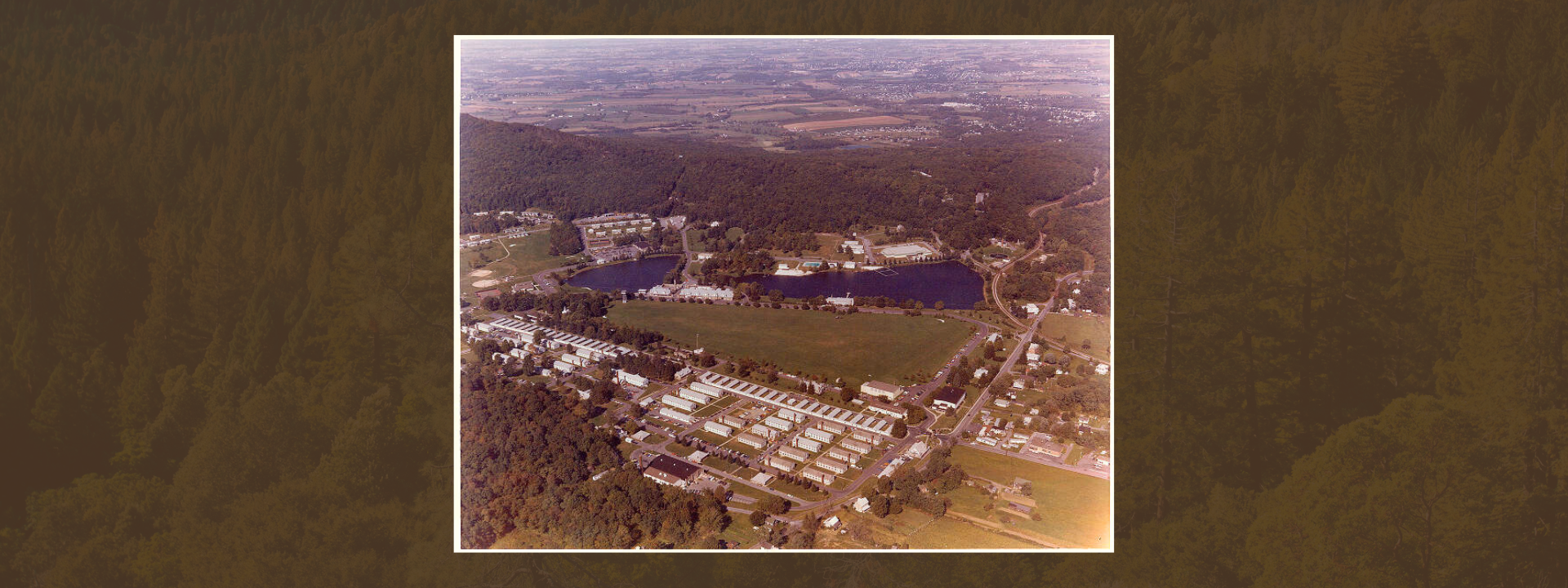
Aerial View of Camp Ritchie During Construction of Barracks, Maryland State Archives
This aerial view of Camp Ritchie shows the barracks under construction. Can you spot the rows of tents?
In the photo below, it is easy to see the remaining evidence of the flat, earthen tiers where tents were set up prior to the barracks buildings being built. This photo faces westward with the Castle Building directly behind the photographer.
Tent Tiers, Sarah Lee Photography, 2024Completed Two Story White Frame Buildings, Maryland State Archives
There were 43 2-story barracks buildings built in total. Each one was desperately needed. As the war waged on, subsequent classes swelled in number as more and more soldiers were sent to Camp Ritchie for intelligence training. Each completed barracks building housed about 50 to 60 men.
Barracks in the Snow, Maryland State Archives81 Mortar — 30 Caliber Platoon, May 18,1945. Ritchie History Museum.
These posing soldiers give a good example of the scale of the barracks and what they looked like in between the buildings. The fenced walkways no doubt acted as a protection for the grass.
WAC Quarters, Hart. Ave., housing area now, Maryland State Archives
When women from the Women’s Auxiliary Corps joined the men at Camp Ritchie in 1944, the building at center-right is where they were housed. The building in the foreground contained offices and a place to relax. The 200 women who served and trained at the camp are legitimately named “Ritchie Girls”. Unfortunately, there is currently very little photo evidence of their activities here during the war.
Camp Ritchie Historic District map, Ritchie History Museum.
This 1997 map of Camp Ritchie, at that point called Fort Ritchie, shows many features that were there during WWII. The structures marked with thin, diagonal lines indicate “temporary WWII wood contributing elements.” The barracks buildings, shown just below the finger buildings, were torn down sometime after the early 2000s.
Outdoor Spaces: Land, Water, & Trees
“We were put into the landscape at night. We had to find our way without a compass or with only a compass and no map. I mean, all sorts of exercises and some of them were quite strenuous.”
– Victor Brombert, Camp Ritchie graduate, “Ritchie Boys” documentary
Aerial View of Camp Ritchie. Ritchie History Museum.
The beautiful, mountainous forest surrounding the fort served as an ideal classroom for the soldiers. Camp Ritchie instructors used the topographical resources well whether it was drilling outside in all weather, building bunkers in the woods, playing war games in the hills, or orienteering in the surrounding forest and countryside.
Captured enemy equipment and uniforms were put to use in training soldiers in the enemy’s fighting tactics, psychology, and Order of Battle, or how an army functioned during war. Dressing in enemy uniforms and speaking in the corresponding languages helped make demonstrations and scenario drills more authentic for students.
They trained on bicycles, motorcycles, with tanks, and horses and in various fighting styles of the enemy within educational structures or navigating within the cover of trees. Where enemy vehicles weren’t available, like tanks, they made mock versions of them using plywood and cardboard to modify army jeeps.
Four Men Leaning on Hand Drawn Fake Tank (Three Men Standing, One Inside). Leonard M. McNutt, Urbane E. Tarver, Sam Griner (Fourth man unidentified), Maryland State Archives.A procession of mock tanks. Ritchie History Museum.
These fake tanks were made of painted plywood set atop army jeeps. Since enemy tanks were in short supply for training, mock tanks made a great substitute.
Several Hundred Soldiers Sitting and Facing House with Open Side. Soldiers on Horses, Pulling Carts with Guns (?) in the Distance, Maryland State Archives.
Camp soldiers watch a demonstration. This fabricated cut-away farmhouse made for easier viewing of acted-out scenarios of the capture and interrogation of prisoners as part of their training.
One of the rooms in the fabricated farmhouse. Maryland State Archives.Ritchie History Museum
This close up is of an actual farmhouse with the side torn away for demonstration purposes. The picture of Hitler on the wall indicates the level of authenticity they sought to achieve in creating a German home.
Below is another photo of the same house, this time showing an audience of soldiers watching men ride up on horses. A megaphone appears to be mounted in the right-hand foreground, indicating there may have been a sound system set up for the audience to hear what was going on around or inside the house.
Horses Pulling Large Wheeled Cart, Running Past House with Open Side—In Foreground are Heads of People Watching the Demonstration, Maryland State Archives.Ritchie History Museum
This snowy photo of soldiers drilling at night on the parade ground gives a good indication of the chilly mountain winters soldiers endured. The Regimental Headquarters is visible in the background.
Japanese Strong Point, Ritchie History Museum
These soldiers utilize a Japanese-style bunker built in the woods. Since Camp Ritchie was surrounded by forest, the cover of trees made an excellent training ground for war exercises such as these.
Below is an outside view of the same style of bunker.
Ritchie History Museum. Man with Rifle Hiding in Woods in Camouflage Sack, Wire Support, Holding Gun, Maryland State ArchivesGerman “stutz punket” (strong point) 30 Cal Machine Gun emplacement, Ritchie History Museum.
In this photo, German uniform-clad students are stationed in a trench with German rifles and a machine gun. These students were expected to speak German fluently, especially while in their roles. Below, students dressed as Germans set up a mortar.
Ritchie History Museum.Soldiers Wearing Helmets in Three Rubber (?) Rafts, Maryland State Archives
Here, students dressed in German uniforms practice water crossings on one of Camp Ritchie’s lakes. One soldier pulls their boat ashore.
The Composite School Unit. A part of the Military Intelligence, showing C.S.U. Members, dressed in German Uniforms and Rifles, a boat landing for the students learning process. Ritchie History Museum.S/Sgt. Marshall Wright in “German” Uniform Taken at Camp Ritchie, Md., C.S.U. Demonstration Troops, Maryland State Archives.
Staff Sergeant Marshall Wright practices camouflaging in a shock of corn. Knowing how to camouflage using anything they could find was an important life-saving skill for soldiers in enemy territory.
Men Marching With One Man on Horse in Front of Row of Military Vehicles on Road. “Sam Griner”. Maryland State Archives.
The Composite School Unit men were responsible for caring for the horses used in training. As Germany and Japan were both still in the practice of using horses, especially early in the war, this was an invaluable part of the training at Camp Ritchie.
In this winter-time photo you can see men drilling in German uniforms with the mock tanks following behind.
Jim Bishop — Camp Ritchie, Md. — C.S.U. — Stable, Coral [sic], Maryland State ArchivesComposite School Unit — Stables Sign, Maryland State Archives. August 1944.Group of Men on Horseback Riding on Dirt Road and Carrying Japanese Flag, Maryland State Archives
Members of the Composite School Unit dressed as Japanese soldiers out on a mounted patrol exercise.
In the photo below, men dressed in Japanese uniforms, one carrying a Japanese flag, navigate terrain in single file. Note the railroad tracks in the top left corner.
Japanese Squad on Patrol, Maryland State Archives
Parts of their field training sometimes involved undignified situations such as the one below.
Lieutenant on Right, Sergeant J.D. Naler (sp?) on Left, Making Japanese Prisoner Undress, Maryland State ArchivesCorporal Harry Calic (sp?) Deploying Japanese Squads, Maryland State Archives
Two men dressed as Japanese soldiers sneak up from behind.
Japanese Squad on Attack. Lt. 1 Rifle Platoon Shot, Sgt. J.D. Naler (sp?) Firing Rifle, Maryland State Archives.
These soldiers are playing war games to practice various scenarios they might encounter overseas. Since the fighting styles of the Germans and Japanese were so different, exercises like these were vital for helping students understand enemy psychology on the battlefield.
Local farmers found themselves in perplexing circumstances as trainees from Camp Ritchie dressed in enemy uniforms navigated the countryside. After awhile, they got used to seeing them and brushed off the odd sightings of “Ritchie Boys.” The following newspaper image is a great illustration of just such a situation.
The Baltimore Sun. 16 Dec 1945. via Newspapers.com
“Blue Ridge farmers, unused even to air-raid alerts, would glance up while plowing to see a file of armed men, low against a forest backdrop, advancing steadily, clad in jungle green, mutteringly unintelligibly, and one of them bearing a flag with the Rising Sun. Or they would come upon scowling figures in field gray.”
– The Baltimore Sun, 16 Dec 1945
” German Mtcl. Platoon – Composite School Unit 1942-1945. This is a German motorcycle Platoon with German uniforms, also operated as a Japanese Motorcycle Platoon and as an American Motorcycle Platoon, a working part of the 81 Motor Platoon, the students could observe each on different problems.” – Alton Needham, Ritchie History Museum
Two (or three)-wheeled transport was another way the students at Camp Ritchie trained. These men are driving German motorcycles with sidecars.German Bicycle Platoon, also Japanese Bicycle Platoon in uniform of each. This was operated by the 30 Cal. Machine Gun Platoon Bicycle Platoon which was a large part of German and Japanese Armies. – Alton Needham, Ritchie History Museum
American military vehicles like trucks and jeeps were also a common sight in and around Camp Ritchie. For locals, it became a common occurrence to see military vehicles going up and down their roads surrounding the fort.
Long Row of Trucks with Weapons Driving on Road. “Sam Griner”, Maryland State Archives
The German Village
Although the exact location of where this village was built is unknown, it served as a realistic setting in which to train soldiers for when they would be in enemy territory. The structures were like a 3-dimensional set and were a memorable feature of training at Camp Ritchie.
“German Village” with Inset of Three Men in Tank “Gerda”. Maryland State Archives.
Man with Camera Standing in Snow in Front of “German Village”. Maryland State Archives.
In the photo below, the sign on this village building says Wirtshaus which means “restaurant or bar” in German.
German Village, Maryland State Archives
In the above photograph, if you look closely at the building second from the left, the sun is casting the shadows of wood scaffolding on its wall. The building on the far left says Gasthof which is a rural German word for “guesthouse”.
German Village – 1946, Maryland State Archives
With the victory in Europe assured in May 1945, the focus of Camp Ritchie training turned to the Pacific Theater and defeating Japan. Here, this haunting picture from 1946 shows a neglected German village with weeds growing up in front.
Recreation & Relaxation
Lake Royer past and present. The Clubhouse which later became the Officer’s Clubhouse and Mess sits on the opposite bank. Maryland State Archives and Sarah Lee Photography, 2024
The recreational opportunities at Camp Ritchie in the beautiful mountain setting lent a resort-like feel to students’ stay. As the population swelled, more amenities were added to keep morale high for the soldiers engaged in their 8-week intensive training. Boating, swimming, fishing, plays, movies, dances and sports, the camp had a wide variety of things to help everyone relax on their time off.
WWII-Era Aerial Map of Camp Ritchie with Recreational Features highlighted, Maryland State Archives. See photo below for a more detailed location of the Mess Hall.Building 360, located at the bottom of the map in gray, made for a very large mess hall, a much-needed accommodation for the heavily populated Camp Ritchie. Camp Ritchie map, Ritchie History Museum.Light on Lake with “Clubhouse” and Other Buildings in Background, Maryland State Archives
Lakes Royer and Wastler were used year round for training and recreation. This picture shows Lake Royer. On the left is a dock with the two-story barracks buildings visible in the background. On the far right is a view of the officer’s Clubhouse.
Break at the Lake, Maryland State Archives
In the soldiers’ off time, the lakes made for a perfect place for relaxing, swimming and boating, possibly even fishing.
Fourteen Men on Baseball Team Posing for Photograph, Maryland State Archives.
Baseball was a popular way for soldiers to relax. This photo showcases a Camp Ritchie team complete with baseball uniform shirts and athletic shoes.
Interior of Gym, Maryland State Archives.
Basketball was another popular sport which was played in the gym at Camp Ritchie. This building is now a community center.
This headline reveals that the Camp Ritchie WACs had an organized basketball team that competed locally! The article goes into more detail:
“This was the first basketball game ever played at Camp Ritchie, and was staged on the new court there. Floor and lighting, according to Paul Shilllow, LKY mentor, was well-nigh perfect.”
The Kenny Letter newspaper from Chambersburg, Pennsylvania. 20 Nov 1945 via Newspapers.com
USO Dance, Maryland State Archives.
Sometimes when a soldier was sent to Camp Ritchie, his wife came along, finding lodging in the towns nearby.
This photo shows soldiers and their dates enjoying a USO-sponsored dance most likely held in Hagerstown, MD, the closest large town.
Post Theater, Maryland State Archives.
The post theater was constructed in 1942. There is evidence that plays were performed here. It’s possible they showed films and held other types of events like dances, performances or military demonstrations. Today, this building is no longer standing.
Below, a soldier dressed in a German uniform gives a demonstration of a German motorcycle for an audience in the post theater.
A man in German uniform rides a motorcycle past a seated audience of men and women, Maryland State Archives.Play at Camp Ritchie During World War II, Maryland State Archives.
Here, the cast of a play poses for a portrait in the post theater. One man on the left is dressed as a woman in braids.
Note the Black pianist in the background who is William Warfield. Drafted into the Army during WWII, he was eventually sent to Camp Ritchie because he was fluent in German. When he arrived and they saw the color of his skin, instead of the intelligence training he was recruited for, they put him in charge of recreation at the camp. This is a reflection of how the other African American soldiers were treated while at Camp Ritchie. They, along with the Native American soldiers, were also housed separately from the other students.
As a trained bass-baritone singer, this role showcased his prodigious skills in music. Warfield was one of at least 48 Black Americans who served at Camp Ritchie. He later became a professor of music and a well-known figure in the entertainment industry including his famous role in “Showboat” singing “Old Man River”.
Dining Hall with Many Picnic Type Tables, Maryland State Archives
Talking and eating together was a great way to relax and socialize. In this photo, the mess hall is being prepared for the next meal.
Another, smaller mess hall was built in Camp Ritchie as pictured below. The presence of women dressed in nurse’s uniforms suggests this was a mess hall for the hospital which was located on the opposite bank of Lake Royer.
Camp Ritchie Mess Hall, Maryland State Archives.
We don’t know exactly everything they ate at Camp Ritchie, though some men remember eating good Italian food prepared by Italian POWs assigned to work in the kitchens. 4
These Camp Ritchie Thanksgiving menus from 1943 and 1944 give us a look at what they enjoyed for the holidays.
1943 Thanksgiving Day Menu, Maryland State Archives1944 Thanksgiving Day Menu, Ritchie History MuseumKitchen with Huge Kettles, Mixer Machine, Maryland State Archives.
Here is a rare look behind the scenes into the Camp Ritchie mess hall kitchen.
This newspaper clipping indicates that some women serving in the WACs at Camp Ritchie also worked in the kitchens.
Great Falls Tribune, Montana, 2 Jan 1944 via Newspapers.comMen in Store Commissary, Maryland State Archives.
Another place to relax and pick up a few needed things was at the post commissary, or grocery shop on base. This photo showcases a busy Camp Ritchie commissary with fully stocked shelves.
Conclusion
While local newspapers from World War II talk about the “intelligence school” in the Maryland mountains, it would be many decades before the knowledge of the hard work and training men and women underwent at Camp Ritchie would be fully revealed. When Fort Ritchie closed in 1998, their work was finally declassified and shared with the world. Today you can read many biographies of individual Ritchie Boys or even watch a documentary about them.
Camp Ritchie’s rich heritage of wartime intelligence work performed by Ritchie Boys and Ritchie Girls impacted thousands of people. Whether it was interrogating POWs on the battlefield, gleaning information from civilians in towns and villages far from home, freeing prisoners from the horrors of concentration camps, or working to interrogate, translate, teach, and support intelligence work stateside, they had a direct influence on how the United States helped win the war.
Wartime Camp Ritchie was a unique, international experiment born out of necessity, bringing together diverse backgrounds and languages. And while prejudice and misunderstanding were still present among the ranks, paradoxically, the training at Camp Ritchie enabled its students to fight against prejudice and intolerance abroad.
The fort with its buildings left behind, whether physically or in memory, help tell their story. They show us the many ways in which the army shaped the camp for their wartime needs, utilized the land to teach and practice intelligence skills, and how important the idyllic natural setting was for their morale during such intensive training. These buildings are a lasting reminder of the rich legacy left by those who passed through Camp Ritchie.
Timeline
1926
Maryland National Guard Training Camp
1942
Military Intelligence Training Camp
1950
Raven Rock Mountain Complex Above Ground Command
1998
Fort Ritchie Closed
1998-2020
Bought and sold by a number of development companies
2021
Ritchie Revival Begins 5
Further Learning
Ritchie Boy Secrets by Beverly D. Eddy, 2021
“The Ritchie Boys”, A Film by Christian Bauer, 2004
A special thank you to Maria Day and Megan Craynon at the Maryland State Archives for their enthusiastic help in allowing me access to the undigitized Fort Ritchie photo collection. And a big thank you to Katy Self, Director of the Ritchie History Museum, for all of her immense help in accessing so many vital pieces of the collection for this project.
1Ritchie Boy Secrets: How a Force of Immigrants and Refugees Helped Win World War II by Beverley Driver Eddy
2Ritchie Boy Secrets by Beverley Driver Eddy
3OSS Training in the National Parks and Service Abroad in World War II by John Whiteclay Chambers II